- Email kabul@aabrar.org.af
- Phone +93(0) 20 223 1250
Established in 1992, the Afghan Amputee Bicyclists for Rehabilitation and Recreation (AABRAR) began as a grassroots initiative to provide mobility and rehabilitation to persons with disabilities (PwDs). Over the decades, AABRAR has evolved into a comprehensive, rights-based organization dedicated to the social, civic, and economic integration of persons with disabilities and other vulnerable groups across Afghanistan.
Since its founding, AABRAR has understood that true independence goes beyond physical mobility; it requires intellectual and economic empowerment. For over 30 years, AABRAR has been bridging the educational gap for marginalized communities, ensuring that children, youth, women, and persons with disabilities have access to quality learning opportunities. Today, AABRAR’s education programs are designed to break the cycle of poverty, address the urgent needs of returnees and Internally Displaced Persons (IDPs), and cultivate the next generation of Afghan leaders and professionals.
AABRAR implements a holistic educational approach, ranging from foundational literacy to advanced university preparation and digital literacy.
1. Community-Based Education (CBE) and Education in Emergencies (EiE)
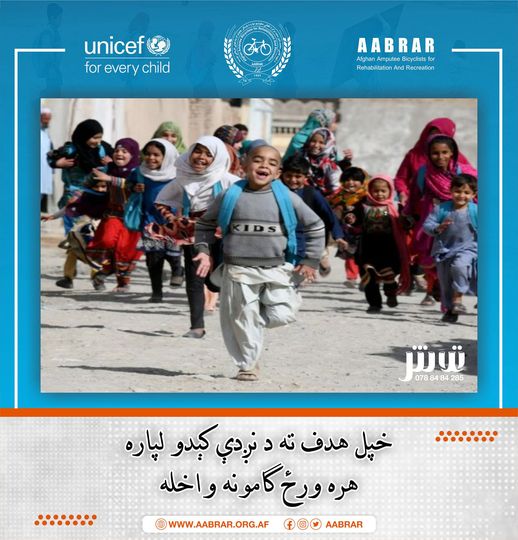
Recognizing the barriers to formal schooling in conflict and disaster-affected areas, AABRAR establishes and supports Community-Based Education (CBE) classes and Accelerated Learning Centers (ALCs).
Activities: AABRAR identifies out-of-school children (OOSC) and enrolls them in CBE/ALC programs. AABRAR recruits, trains, and deploys local teachers, distributes essential Teaching and Learning Materials (TLM), and constructs gender-sensitive latrines. AABRAR ensures that at least 50% of out-of-school children enrolled are girls.
Generous Donors: These critical emergency education initiatives are generously funded by UNICEF and the Afghanistan Humanitarian Fund (AHF/OCHA).
2. Foundational Literacy and Numeracy
For adults and older youth who missed out on early education, AABRAR provides targeted literacy and numeracy programs.
Activities: AABRAR conducts basic education and literacy classes designed to equip vulnerable individuals with foundational reading, writing, and math skills. These skills are critical for AABRAR's beneficiaries to manage their daily lives, run small businesses, and understand their basic rights.
Generous Donors: AABRAR’s historical and ongoing literacy programs have been supported by donors such as DAI, USIP, and Counterpart International.
3. University Entrance Exam (Kankor) Preparation
Higher education is a key pathway out of poverty, but the Afghan university entrance exam (Kankor) is highly competitive.
Activities: AABRAR organizes comprehensive university entrance exam preparation courses specifically for fresh grade 12 graduates from vulnerable backgrounds. AABRAR has successfully implemented these programs across multiple provinces, including Paktika, Kunar, and Nangarhar, providing students with the academic boost they need to secure university placements.
Generous Donors: AABRAR’s Kankor preparation courses have been made possible through the generous support of DAI (Development Alternatives, Inc.) and ASI (Afghanistan Stabilization Initiative).
4. Youth Development and Higher Education Scholarships
AABRAR believes in investing in the youth of Afghanistan.
Activities: AABRAR offers university scholarship opportunities for youth who have completed high school but cannot afford tuition. AABRAR specifically earmarks scholarships and educational support for youth with disabilities, ensuring they can pursue higher education and become professionals in their communities.
5. Professional Skills, English, and IT Courses
To link youth to the job market and government employment, AABRAR provides practical, market-driven educational courses.
Activities: AABRAR conducts English language programs, computer and internet courses, and computer hardware/software training. AABRAR also organizes youth debates for university and high school students on important social and civic topics, fostering critical thinking and public speaking skills.
Generous Donors: AABRAR’s youth empowerment and capacity-building courses have been supported by DAI and USIP (United States Institute of Peace). AABRAR’s Women's Internship/Fellowship program, which places female graduates in government departments, is supported by The Asia Foundation.
6. Digital and Media Literacy (MMPC & Resource Centers)
AABRAR operates Multi-Media Production Centers (MMPC) and Resource Centers to foster digital literacy.
Activities: At the MMPC in Jalalabad and Resource Centers in Nangarhar, Paktia, and Parwan, AABRAR provides free access to the internet and libraries. AABRAR offers free training in basic computer skills, photography, photo/video editing, videography, digital storytelling, and blogging to students, journalists, CSOs, and persons with disabilities.
Generous Donors: AABRAR’s media and digital literacy initiatives have been supported by INTERNEWS.
7. School Infrastructure Construction & Accessibility
AABRAR is committed to rebuilding Afghanistan’s educational infrastructure.
Activities: AABRAR has physically constructed and rehabilitated schools to provide safe learning spaces. Furthermore, AABRAR integrates physical accessibility into all its education infrastructure projects by constructing ramps and accessible pathways, ensuring that students with physical disabilities can easily access classrooms.
Generous Donors: AABRAR’s accessibility and infrastructure projects have been generously funded by Clear Path International and the European Union (EU).
AABRAR’s educational initiatives are designed to support the most marginalized and at-risk segments of Afghan society. The primary beneficiaries include:
Out-of-School Children (OOSC): Children affected by conflict, poverty, or displacement, with a priority on ensuring 50% female enrollment.
Persons with Disabilities (PwDs): AABRAR ensures that individuals with physical or sensory impairments are provided with accessible education, scholarships, and specialized support.
Returnees and Internally Displaced Persons (IDPs): Families forced to flee their homes who lack access to formal schooling and educational resources.
Vulnerable Youth and Young Adults: High school graduates needing university preparation (Kankor), and youth seeking English, IT, or media skills to enter the workforce.
Female Students and Professionals: Women and girls who have historically been denied educational opportunities, ensuring they have access to literacy, higher education, and digital skills.
Teachers and Local Educators: Local community members recruited by AABRAR who receive specialized training and Teaching and Learning Materials (TLM) to deliver effective education.
Journalists and Civil Society Actors: Individuals utilizing AABRAR’s Multi-Media Production Centers to enhance their media literacy and digital storytelling capabilities.
AABRAR’s ability to deliver high-quality, impactful educational programs across Afghanistan would not be possible without the generous, ongoing support of its international and national donor partners. AABRAR extends its deepest gratitude to the following organizations for their commitment to Afghan education:
UNICEF
Afghanistan Humanitarian Fund (AHF/OCHA)
European Union (EU)
United States Institute of Peace (USIP)
The Asia Foundation
DAI (Development Alternatives, Inc.)
ASI (Afghanistan Stabilization Initiative)
Counterpart International
Clear Path International
INTERNEWS
(Additional AABRAR multi-sector donors include: UNDP, UNHCR, WHO, WFP, UNOPS, USAID, and the Canadian Embassy).
Through these comprehensive education initiatives and the unwavering support of its partners, AABRAR continues its 34+-year mission of turning vulnerability into capability, ensuring that every Afghan has the right to education, social justice, and equality.
Copyright 2026 AABRAR NGO. Powered By AryanIct
